
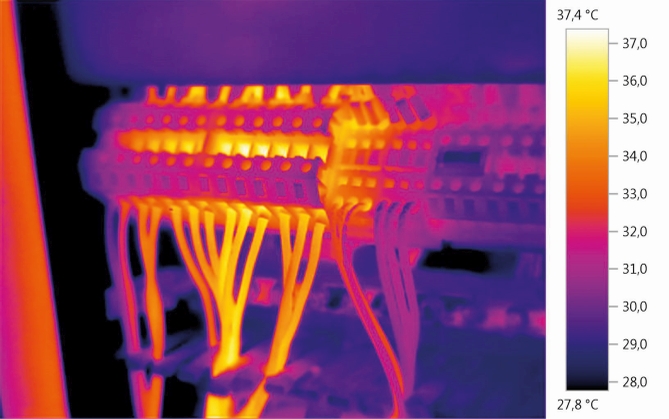
Thermal imaging can be used to examine electrical installations in industrial and commercial settings. It can help identify temperature variations that may warrant further technical assessment.
Electrical systems, although durable, should always be regularly inspected and maintained to prevent any faults from occurring over time, from increased contact resistance, loose connections, to imbalances or overloads. Electrical devices and networks are prone to failure due to high temperature and resistance. These two factors can cause significant damage and disruption if not properly addressed.
How does thermal imaging help us identify faults in electrical installations?
Each element of any electrical installation has a specific resistance and in turn consumes energy. Thus, the total power consumed depends on the resistance of the components. Improperly assembled machines and appliances may experience increased resistance due to construction or installation faults.
An increase in the resistance of a component leads to a higher power consumption, thus it will result in more heat being released during the process. Thermographic inspection is a tool that helps to identify elevated thermal points that may be caused by faulty equipment, loose connections or high contact resistances.
Thermal imaging cameras are able to detect temperature rises in electrical components before they fail, which is a very useful tool. It provides early detection so companies can take the necessary steps to prevent potential problems.
Thermal imaging may help identify elevated temperatures that could indicate a developing issue. Any effect on fire risk, service interruptions or maintenance costs depends on the installation and timely follow-up.
Which installations can be checked by Thermography?
– Lighting panels and sockets;
– general electrical panels;
– electrical substations, transformer stations;
– main circuit breakers, load breakers
– UPS
– control panels for various machines, motors, etc.
– AAR
– stationary batteries
– capacitor banks
What can we detect with Thermovision?
– imbalances in the three-phase electrical network
– overload of circuits or equipment
– faulty protective devices
– loose or damaged connections
– inductive heating
– presence of harmonics
What are the signs that we should carry out a thermal imaging inspection?
The need for thermographic inspection and its frequency depend on the type of installation, operating conditions and applicable technical requirements. Thermal imaging can help identify temperature anomalies but does not by itself confirm that an installation is in optimal working order.
Thermal imaging can provide information about the condition of electrical components. Findings should be assessed by a qualified professional and followed by any necessary corrective action.
ELECTRO INSTAL CONSTANTIN offers professional electrical installation testing services ensuring the safety and efficiency of your systems. Popular services include PRAM checks to assess your grounding installation and PAT testing for electrical equipment and for the Electrical Installation Thermal Imaging procedure.